Showing posts with label Cars. Show all posts

Top Five New Family Hatchbacks For Under €25,000

Our partners - and new car review experts - at CompleteCar.ie have compiled a list of the best five family hatchbacks €25,000 can buy. While we all agree that the Volkswagen Golf is still the class-leader, the revitalised Focus runs it very close. Other than those two, the cars listed are not in any particular order - mainly because we can't agree amongst ourselves on it! And for those with a hankering for something a little more exciting, we're included a wild card used option for the same money.

1 - Volkswagen Golf - the classy one

Plus: Tangible quality, great all-rounder
Minus: Greatness comes at a price
  • Pricing: from €19,995 to €35,035
  • Popular engines: 1.2 petrol, 1.6 diesel
  • Power output: 110hp
  • Fuel consumption: 3.8- to 4.9 litres/100km
  • Road tax: Band A2 to A4 (€180 to €200)
  • Safety: five stars from Euro NCAP, including 89% child occupant protection 
The Golf name has been a major part of the family hatchback segment for almost as long as the segment itself has existed. Now into its seventh generation the Volkswagen continues to set the benchmark both in terms of build quality and overall desirability. Available in three- and five-door versions, as well as an estate and high-roofed SV models, the Golf offers a range of petrol and frugal diesel engines - there’s even an electric variant. Where the Volkswagen excels though is in how good it feels from behind the wheel. It might not be the cheapest car in its class, but it has the feel of a car costing even more. Strong residuals help offset the initial purchase price too.

2 - Ford Focus - the one for drivers

Plus: Improved looks, great to drive
Minus: Now on the wrong side of pricey
  • Pricing: from €20,695 to €30,490
  • Popular engines: 1.0 petrol, 1.6 and 2.0 diesel
  • Power output: 95- to 150hp
  • Fuel consumption: 3.8- to 6.3 litres/100km
  • Road tax: Band A2 to C (€180 to €390)
  • Safety: five stars from Euro NCAP, including 82% child occupant protection
We still think the first-generation Focus looks great and it drove far better than anything else at the time. After a few less interesting versions Ford is back with a new Focus that recaptures that specialness. Updates to the styling give it a much smarter appearance, while the look and feel of the interior have been greatly improved - although this has also been reflected by an increased price tag. Supple suspension and involving steering serve to justify this, however. Many will be drawn to the diesel engine range, but our pick would be the surprisingly efficient 1.0-litre petrol EcoBoost engine - ideal for those that don't travel more than 15,000km a year.

3 - Peugeot 308 - the one for gadget fans

Plus: Stylish looks, good specification
Minus: Rear seats slightly cramped
  • Pricing: from €19,215 to €29,895
  • Popular engines: 1.2 petrol, 1.6 and 2.0 diesel
  • Power output: 82- to 150hp
  • Fuel consumption: 3.6- to 5.8 litres/100km
  • Road tax: Band A2 to A4 (€180 to €200)
  • Safety: five stars from Euro NCAP, including 79% child occupant protection
In the style stakes Peugeot’s 308 is quite a handsome contender in what is often a more practical-centric segment. The interior features a very minimalist design, with many of the additional controls, such as air conditioning, operated via the dashboard-mounted touchscreen. Perhaps the most divisive thing is the 308’s small steering wheel, but trust us, you do get used to it. On-road manners greatly improved over its predecessor and while the diesel engines perform well, we’d also recommend looking at the new PureTech petrol engine. Peugeot has also put together some well-equipped trim levels, with many usual optionally extras coming as standard.

4 - Kia c’eed - the value-for-money one

Plus: Stylish looking, seven-year warranty
Minus: Not as much fun to drive as some
  • Pricing: from €19,104 to €27,190
  • Popular engines: 1.4 petrol, 1.4 and 1.6 diesel
  • Power output: 90- to 128hp
  • Fuel consumption: 4.3- to 6.0 litres/100km
  • Road tax: Band A4 to C (€200 to €390)
  • Safety: five stars from Euro NCAP, including 88% child occupant protection
Less than the length of a new Kia’s warranty ago, the Korean car maker was guilty of producing somewhat dull cars. Nonetheless, the latest cee'd has been designed with European markets and tastes in mind and from the outside it does appear smart. It feels solid too, the doors shutting with a reassuring thud and inside, the plastics look and feel more expensive than in previous Kias. Dynamically it doesn’t rival the Focus, for example, but the Kia is a good car by any measure. Factor that seven-year warranty and keen pricing into the mix and it makes a good case for itself.

5 - SEAT Leon - the stylish one

Plus: Solid drive, good value for money
Minus: Interior is a touch basic
  • Pricing: from €19,395 to €29,225
  • Popular engines: 1.2 and1.8 petrol, 1.6 and 2.0 diesel
  • Power output: 86- to 184hp
  • Fuel consumption: 3.8- to 5.9 litres/100km
  • Road tax: Band A2 to B2 (€180 to €280)
  • Safety: five stars from Euro NCAP, including 92% child occupant protection
If you’re not overly concerned about what the badge on the front of your car says then the SEAT Leon makes a lot of sense. Under the stylish bodywork are effectively much of the same mechanicals as the class-leading Volkswagen Golf. As SEAT continues to try to lose its ‘runt of the litter’ image within the Volkswagen Group, its prices have remained highly competitive, especially given how well the car drives on the road. The interior isn’t quite as plush as the Golf's, but it is still far from sub-standard.

Wildcard choice
How about spending your €25,000 on a used hot hatch instead? There's plenty of choice for that amount of money. Here we look at one of the most extreme.

Mégane Renaultsport

Plus: Incredible dynamic ability
Minus: Thirst for petrol
  • Engine: 2.0 petrol
  • Power output: 265hp
  • Fuel consumption: 8.3 litres/100km
  • Road tax: Band E (€677)
Let's not beat around the bush here; the Mégane RS is one serious hot hatch. End of. It has a slick manual and it’s powered by a feisty 2.0-litre turbocharged four-cylinder engine that produces 265hp. And to top it off it has one of the finest chassis in the segment. Are you sensing our enthusiasm at the prospect of this as an alternative family car? Hands down it is a terrific car that is as good on track as it is on your favourite B-road. You may have difficulty convincing the other half that you'll fit child seats in the back, however...

Best Lego Cars of All Time?

On the eve of the release of 'The Lego Movie' we've taken a look at some of the coolest Lego cars out there. The iconic building blocks have been a part of many a childhood since the late 1940's. It's recognised and loved the world over by children and adults alike. The simple blocks encourage imagination and creativity so we've picked a few of our favourites below;

This model authentic camper van is a replica of the classic Volkswagen Camper Van from 1962.


Ford created a full-size replica of the company's Explorer crafted from Lego bricks. The sculpture was created by 22 designers over the course of 2,500 hours. All told, there are 380,000 individual bricks.


The iconic DeLorean time machine that Dr. Emmett ‘Doc’ Brown and Marty McFly famously used to travel Back to the Future!


The full scale replica of the 2011 Ferrari 150 ° Italia was built by a 16 strong team of Lego experts. It took six months to design and plan the task and a further ten days to assemble the hundreds of thousands of Lego bricks, fixing them onto a steel chassis. The car features real Pirelli race tyres, a seat that’s big enough to accommodate a driver and an exact replica of the steering wheel, this too made entirely from Lego.


And last but by no means least;

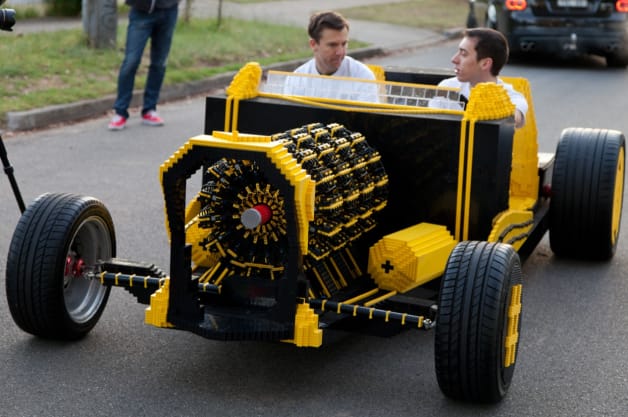
The end of 2013 saw the worlds first life sized air-powered Lego car that could be driven. The project was undertaken by an Australian entrepreneur and a Romanian technologist and took more than 500,000 pieces to construct. Apart from the wheels everything was Lego. It is powered by four orbital engines with 256 pistons running on air. With top speeds of roughly 20-30km/h it's no getaway car but with something that looks this cool why wouldn't you take your time to show it off!


Words by Lisa Carroll, That's What She Said! 

Tell me when to STOP!

If, like me, your car is a bit more vintage (others would say old and beaten) than modern, it may well not have all the bells and whistles or luxuries of a newer model, such as parking sensors. This came to my attention the other day, when my other half was parking my car. He just kept reversing until I gave a yelp as I could taste the wall behind us, and had visions of us being buried beneath a pile of rubble never to be found again. He was so used to his own car and his parking sensor he was just waiting on the beep regardless of the impending wall! 

So yes reversing is all about spatial awareness, knowing the size of your rear and utilizing your mirrors but parking sensors are a great aid to give you that extra confidence reversing and reduce the odd fender bender from a misjudged/miscalculated space.

"Know the size of your rear"
Here's one creative way of making your own parking sensor which appears to do the trick nicely;


However if you don't happen to have a stash of balloons handy or the patience to blow one up for every journey you take, we also have a few options available here with great savings at MicksGarage.com 


Words by Lisa Carroll, That's What She Said! 


Build Your Own Car

Remember that classic Johnny Cash song 'One Piece at a Time' where he sings about a guy working at a car manufacturing plant, who slowly, over the space of a number of years, builds his own car, one piece at a time that doesn't cost him a dime! If like me, when listening to it, you thought God I would love to do that; build my own car...bit by bit, right from the start.

Well now you can! Yes that's right, the very first 'open source' car has been developed, which, with a few additions can be road worthy. It's the stuff of every boys dream. The genius engineers that developed it have even said that you can have your own homemade car put together in just 1 hour...that's the same time it would take to make an apple tart! Take your pick lads!

The car in question here is the OSVehicle Tabby, who are already taking pre-orders already for the 2 and 4 seater configuration for only €500,  Add 'optionals' like a battery pack for €698, electric powertrain for €1,520, and seats, which are surprisingly important, for €80.

OSVehicle Tabby


Ordering couldn't be easier; you simply select the elements you want online before it gets delivered flat-packed directly to your door ready for assembling - it's the IKEA of cars! The lads at OSV is also working on expanding the drivetrain options to include a choice of three electric motors, petrol-electric hybrids (a 125cc engine partnered with a 15 kW motor) or traditional internal combustion engines ranging in size from 50 to 250cc

As the car is 'Open Source' you can download all blueprints online, make tweaks yourself, recommend overall changes and basically watch as the car community build the car they want to see, is this the future of car manufacturing?

See how it's all done here - a thing of beauty:


Words by John Smyth, MicksGarage Marketing Guru! 

Choosing A Trackday Car On A Budget

Here at MicksGarage we love track days. We love them because they are awesome. Fact. They also represent the best value for money you can get in more or less any form of motorsport, in terms of actual time spent driving your car.

If you can find a track day that runs an 'open pitlane' like they do at our local track Mondello Park (where you can go out on track as and when you please) then you can stay out on track in your car from the moment the lights turn green to the moment the chequered flag is waved.....granted you'll have run out of petrol ....and brakes....and tyres....and probably concentration long before that! but in theory at least, it is possible, and you just don't get that kind of value anywhere else.

So, you've decided you want to give trackdays a go and you want to get yourself a suitable car. Let's assume you have a small-ish budget of around €/£2500. Before you start looking at cars, you have a number of choices to make:

Does the car need to be road legal? ie are you planning on driving it to and from the track?
If so it will need an NCT/MOT, tax, insurance and it will want to be fairly reliable, all things which will add to the cost of the car

Can it be for track only?
If so, you may be able to get a bit more car for your money because you don't need tax, test and insurance, but you will need to factor in the cost of a trailer and a towbar.

Standard or modified?
So do you choose a car that is bog standard or one that has already had money spent on it preparing it for track use?
Both options have their pro's and con's. With a 'standard car' you're getting just that, a standard road car that wasn't designed to be thrashed on track lap after lap, as such, a number of components will without doubt need upgrading and after your first trackday the modifying bug will probably bite and you'll be looking for better brakes, better cooling, more grip and most likely, more power! all of which cost money. On the positive side though, you wont be inheriting anybody else's problems or poor workmanship and you can put your own stamp on the car.

Going the modified route could save you money as long as the modifications are sensible. If I were looking for a previously modified car I'd hope to see uprated brake pads, bigger brake rotors, adjustable dampers, uprated springs, decent tyres and maybe even a stripped out interior with a set of good bucket seats and harnesses. Personally, and depending on the car i'd rather buy a car with a relatively standard engine than one that has loads of modifications. This is purely from a reliability point of view, it's just a plain and simple fact that as soon as you start increasing the power output of an engine you start to reduce its life expectancy.
In addition, if you're buying a car that has been modified for track use, you're buying a car that has without doubt been driven very very hard.

Front wheel drive, rear wheel drive or 4 wheel drive?
This is really a matter of personal preference as each format will handle and perform differently.
Speaking in extremely general terms;

Front wheel drive cars may cost a bit less to purchase, offer more familiar and predictable handling, may be more suitable for a complete novice, may be smaller, lighter and be quicker through the bends than the 4wd and rwd equivalents. They may have a bit less power and are more likely to be normally aspirated than turbo charged. Typical power outputs in this price bracket will range from about 100bhp to 190bhp

Rear wheel drive cars are probably the most fun and most rewarding to drive. If you choose the rwd route you will probably have a good choice of turbocharged or normally aspirated engines, front engined or mid engined, coupe, saloon or convertible. Handling will be the most engaging of the 3 formats and in the wet, probably quite a handful! In terms  power outputs you could be looking at a number of cars with 300+ bhp

4 wheel drive may be the most expensive route. The 4wd layout doesn't necessarily lend itself to circuit racing and really there's no massive benefit to 4 wheel drive on track unless the weather is atrocious or you have absolutely huge power figures, but that's not to say that 4 wheel drive should be discounted by any means. Over the last few decades some of the most amazing real-world performance cars have been 4wd and now some have them are well within our price bracket!
If going the 4wd route, expect 4 cylinder turbo charged engines, 200bhp+ in standard form, handling that errs on the side of understeer but overall, high levels of grip and excellent performance.

The Cars:
Front wheel drive -
You get a great choice of front wheel drive cars for our fictitious budget of about €/£2500. My shortlist of cars would be:
  • Renault Clio 172
  • Alfa Romeo 156 V6
  • Honda Civic Type R / Integra / Accord Type R / CRX
  • Peugeot 106 Rallye / 205Gti
  • VW Golf Gti
  • Fiat Coupe Turbo
  • MG ZR / ZS
If i had to pick one it would probably be the Renault or the Civic. The Clio 172 can be purchased for very small money, which would leave you plenty of spare cash to spend on tuning! And don't forget, you'll need to leave some budget to spend on the actual trackdays themselves, no point having an awesome car if you cant afford to use it! (believe me I know!)
The Honda's have the infamous V-Tec engine and in some models are producing close to 200 bhp in standard form. They're also a good choice because there are just so many aftermarket tuning parts and spares available for them.

The curve ball in the list is the Fiat Coupe Turbo. It has a wonderful 5 cylinder engine that produces 217bhp standard that can easily be increased to 250+ with a remap and exhaust/inlet modifications. Parts however may be scarce! The 2.5litre V6 version of the MG ZS is also a surprisingly impressive car, it has 180bhp as standard, has well engineered handling. reasonable brakes and it sounds awesome!

Rear wheel drive -
For €/£2500 you can get some properly serious rear wheel drive machinery. Here's my shortlist

  • BMW E36 M3
  • Mazda MX5
  • Porsche 944
  • Toyota MR2 mk1 / mk2 / MRs
  • Nissan Sylvia S13 / S14 / 200SX
  • Nissan Skyline GTST
  • Locost / MNR / MK/ Westfield 7
Picking a car from this list would be really tough - I want them all! The BMW will blow every cent of your budget but you'll get 321bhp from that glorious sounding straight 6 engine. The MX5 and the Toyota MR2's represent excellent value for money and if you can get over the slightly 'hairdressery' image you'll have a great, fun, quick little car with the added benefit of left over budget for tuning. Plus they're the only convertible cars here.
Who wouldn't want to own a Porsche, and yes you can get one for less than 2.5k! but it will only be the 4 cylinder 944 or 924, sadly not the flat 6 boxer in the 911. Performance might not rival some of the other cars here........but you'd own a Porsche!
The Nissan Sylvia S chassis cars are a good choice and are a favorite of the drifting fraternity. Primarily because large power can be extracted from the 2 litre turbo 4 cylinder engine for very little effort and money. a safe 300-400bhp can be achieved for probably less than a grand.
The Locost / MNR / MK/ Westfield 7 are all kit cars based on the Caterham 7. A car like this will offer unrivaled performance but at the cost of a roof, doors or maybe even a windscreen! I even found an example, in budget with ZX9 bike power! With the right engine, these machines will blow away pretty much anything else on track. One word of warning though, this type of car is virtually useless in the wet as they're just too light to get the power down! 

4 wheel drive -
Again, for €/£2500 you can get an awful lot of 4wd car for your money. Here's my shortlist
  • Audi S2 / S4
  • Subaru Impreza / Legacy
  • Mitsubishi Evo 4
  • Nissan Pulsar GTiR  

The pick of the bunch would probably be the Evo. The Audi's, the Legacy and the Pulsar all offer something a bit different if you want to go against the grain, but ultimately wont be as quick, as tune-able or as reliable as the Evo. With 280bhp, good brakes, clever diffs and decent suspension as standard the Evo 4 offers impressive performance. 
The Subaru Impreza would also be a good choice and the 4 cylinder boxer engine does have a wonderful character that the Evo just cant match. In Budget you could even be looking at STI or WRX versions.

So that's it, our basic guide to buying a track car for about €/£2500!